Pattern
May 2026 · Accelerate 2026
Creative Technology · Interactive Development · On-Site Integration
DB Productions, event production partner
Overview
For Pattern’s Accelerate 2026 conference we designed and built an interactive digital mirror on a curved LED wall outside the main hall. It carried the event’s visual identity, and it switched on its own between branded content and mirroring whoever walked up.
The Experience
People walked up and saw themselves. That was the whole instruction set. The system tracked several people at once and rendered each of them as a grid of dots pulled from the Accelerate 2026 identity. Through the event, attendees stopped, gathered, and took photos in front of it.
Customized to the Brand
The captured point cloud rendered as a dotted grid in the Accelerate 2026 style, so the mirror looked like the rest of the event rather than a generic effect bolted onto it.
The wall had an idle state and an active one. With nobody in the capture area it showed a slowly rotating Accelerate logo built from the same dots. Once there was enough movement in front of it, it faded into the mirror.
So the wall still worked as branded event content when nobody was in front of it.
Built for the Space
The wall was a curved half-column, and a conventional digital mirror on a curve distorts people noticeably. We built a custom reflection system in TouchDesigner using ray tracing, with an adjustable focus parameter, so we could trade physical accuracy for a reflection that looked natural.
Two Hours From the Case
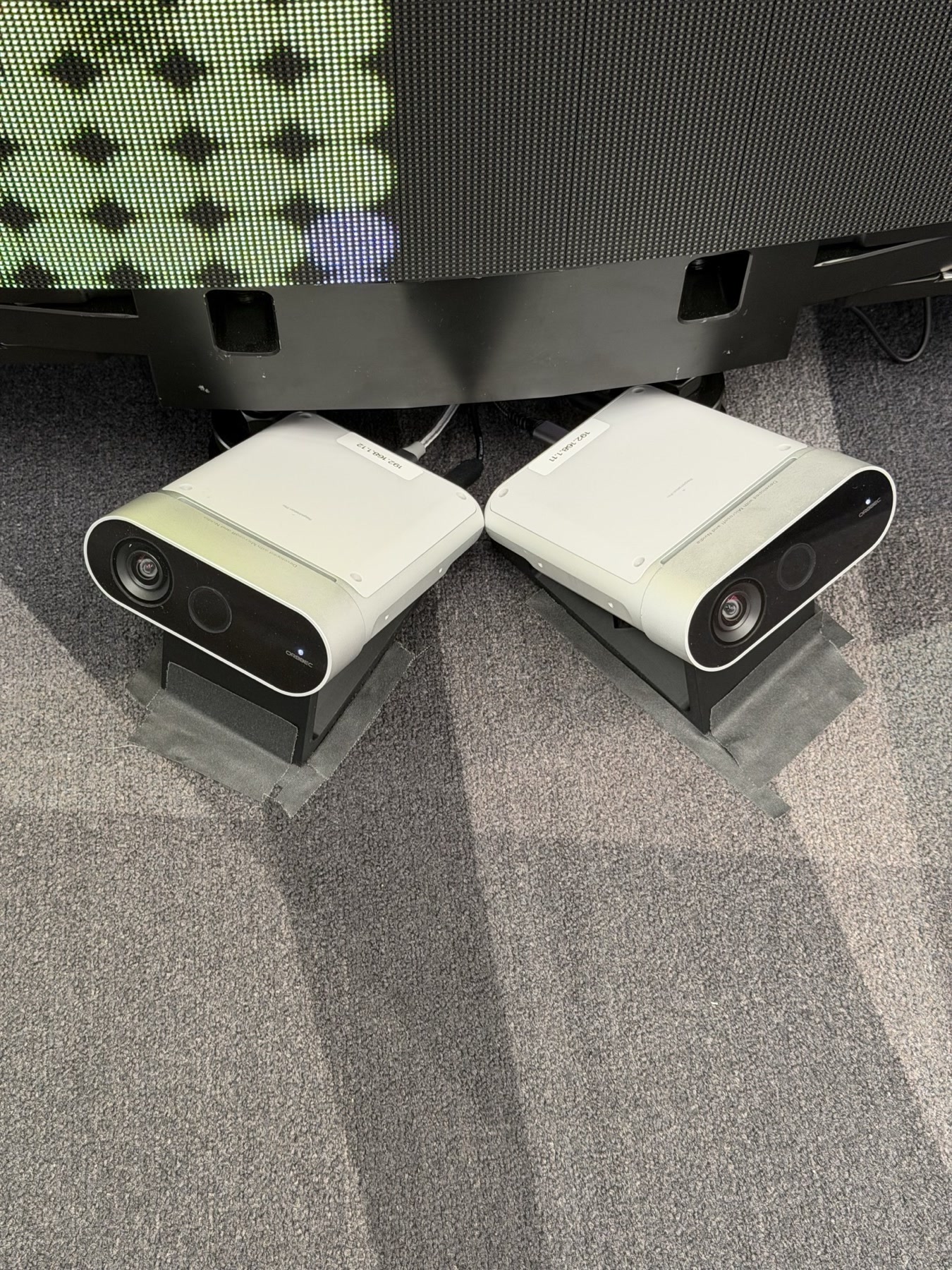
DB Productions sent us the wall specs ahead of time, so the resolution, the calibration tools, and the sensor mounts were all ready before we flew. Two Orbbec Femto Mega depth sensors covered the interaction area from 3D-printed mounts at the base of the wall, with custom TouchDesigner tools to align them in one shared 3D space and filter for depth range, capture volume, and noise.
On site, the first two hours went like this: plug everything in, set the sensors on their mounts and tape marks on the floor in case they get bumped, run calibration to check the two point clouds merge correctly, set the depth filters for how far out from the wall people should register, tweak the scale of the reflection, get sign-off from the Pattern creative team. Then it ran.
Technical Specifications
- Display
- Curved half-column LED wall
- Sensors
- 2 × Orbbec Femto Mega depth sensors
- Render engine
- TouchDesigner: point cloud rendering with custom ray-traced reflection
- Scripting
- Python
- Calibration
- Custom TouchDesigner tools: shared 3D sensor space, depth range, capture volume, noise reduction
- Mounting
- 3D printed custom camera mounts
- States
- Idle rotating logo → interactive mirror (automatic transition)
- Setup
- Operational roughly two hours after unpacking
- Run
- May 2026 · Accelerate 2026
What Else Is Possible
The tracking and the rendering are separate pieces, so the same system can wear any brand’s look, run on a flat wall or a curved one, and drive anything from a digital mirror to a photo booth to a touchless presentation.